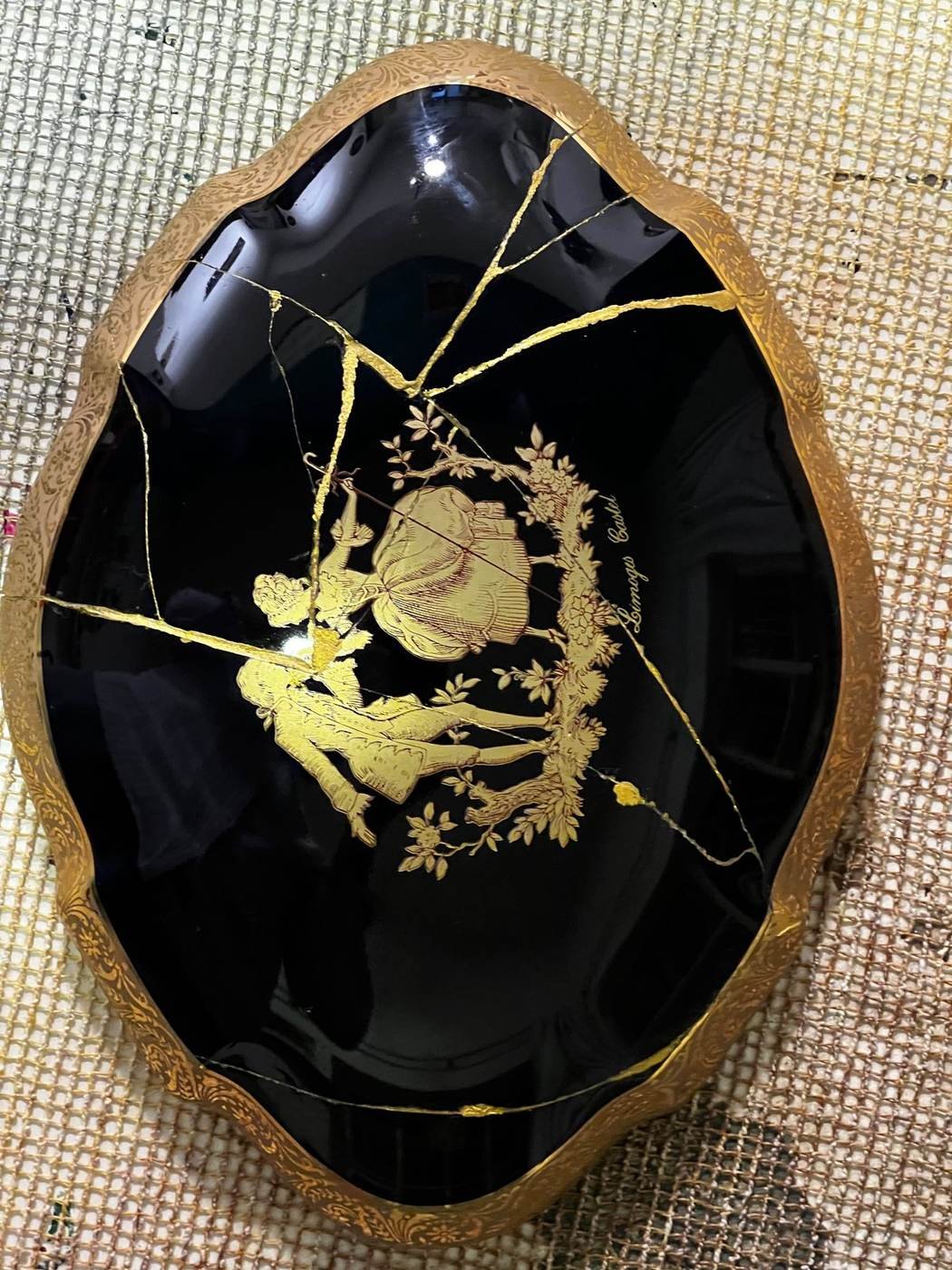
Some objects are not replaceable. A cup that belonged to a grandmother. A plate from a set that no longer exists. A gift from someone who is no longer here. When one of those breaks, throwing it away is not really an option — and hiding the repair misses the point.
Kintsugi is the Japanese practice of repairing broken pottery with gold. The seam is not disguised. It is made the most beautiful part of the object, because the break is now part of its history. We are the first and only studio in Jordan to teach and repair Kintsugi, and we repair pieces for people across the country.
How it works
Four steps
- Send us a photo. Message the broken piece to us on WhatsApp — all the fragments, laid out if you can. This costs nothing and takes a minute.
- We assess and quote. We will tell you honestly whether it can be repaired, what the result will look like, and what it will cost.
- Bring it to the studio. We will arrange a time. Seeing the piece in person matters for anything complicated.
- We repair and you collect. We will give you a realistic timeline once we have seen it, and tell you how to care for the finished piece.
What we can repair
Ceramics, porcelain, stoneware and some glass. Clean breaks are straightforward. Many fragments is harder but usually possible. Even where pieces are missing entirely we can rebuild and shape the gap — a repair the Japanese call kake — so the object is genuinely whole again rather than simply held together.
If we do not think a piece can be saved, we will tell you that rather than take the work.
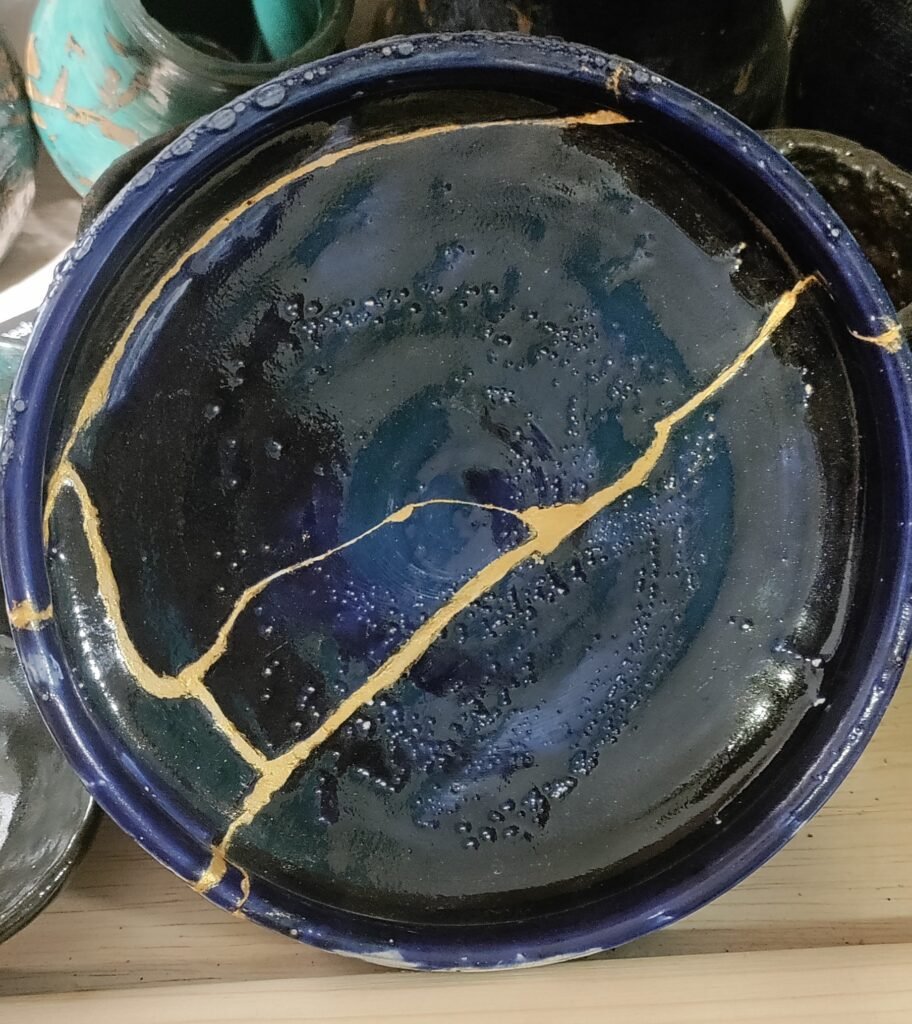
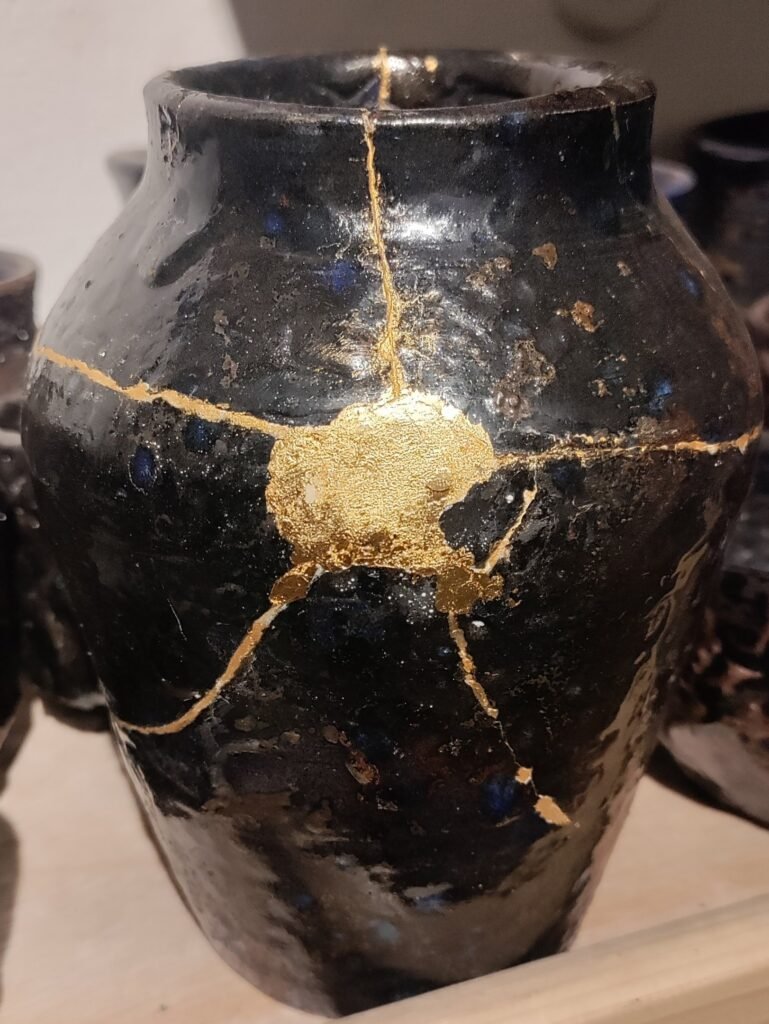
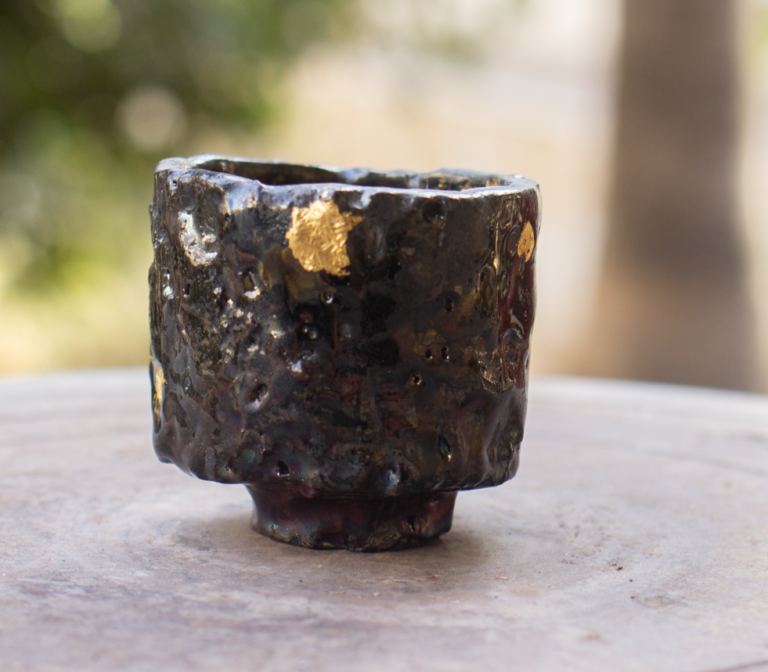
The four kinds of repair, and what they are called
Kintsugi has its own vocabulary, and knowing it helps when you describe your piece to us. Every break falls into one of these.
Hairline crack ひび · hibi
A line has appeared but the piece is still in one part — nothing has fallen away. The crack is sealed and the line drawn in gold. This is the simplest repair, and often the most delicate to look at afterwards.
Break 割れ · ware
The piece has come apart, but you still have every fragment. We rejoin them with lacquer and rice glue, then gild the seams. Two clean halves are straightforward; fifteen fragments takes longer but is usually still possible — keep every piece, however small.
Chip 欠け · kake
A fragment is gone. A bite out of a rim, a missing corner, a lost foot. Because there is nothing to glue back, the gap has to be rebuilt from scratch with a putty of lacquer and clay powder, shaped, sanded and then gilded. More work than a break of the same size, which is why it is priced by the area we have to rebuild.
Patchwork 呼び継ぎ · yobitsugi
Instead of rebuilding the missing area, we set a fragment from a completely different vessel into the gap and join it in gold. The result is deliberately mismatched and quietly startling — two objects with separate histories in one bowl. It asks for more skill than any other repair, and it is the one that can leave a piece worth more than it was before it broke. Ask us if you are curious; it is quoted per piece.
A repair, start to finish
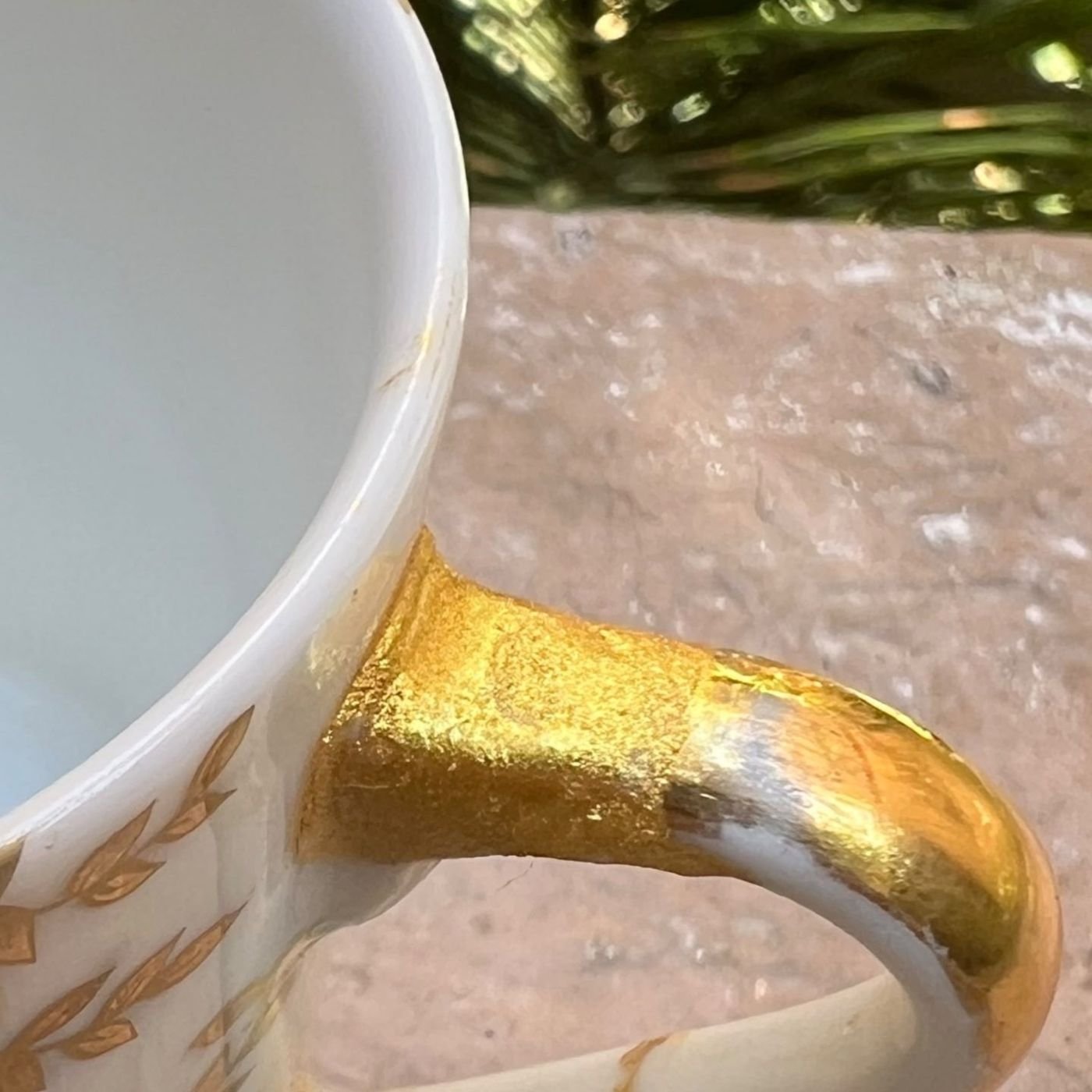
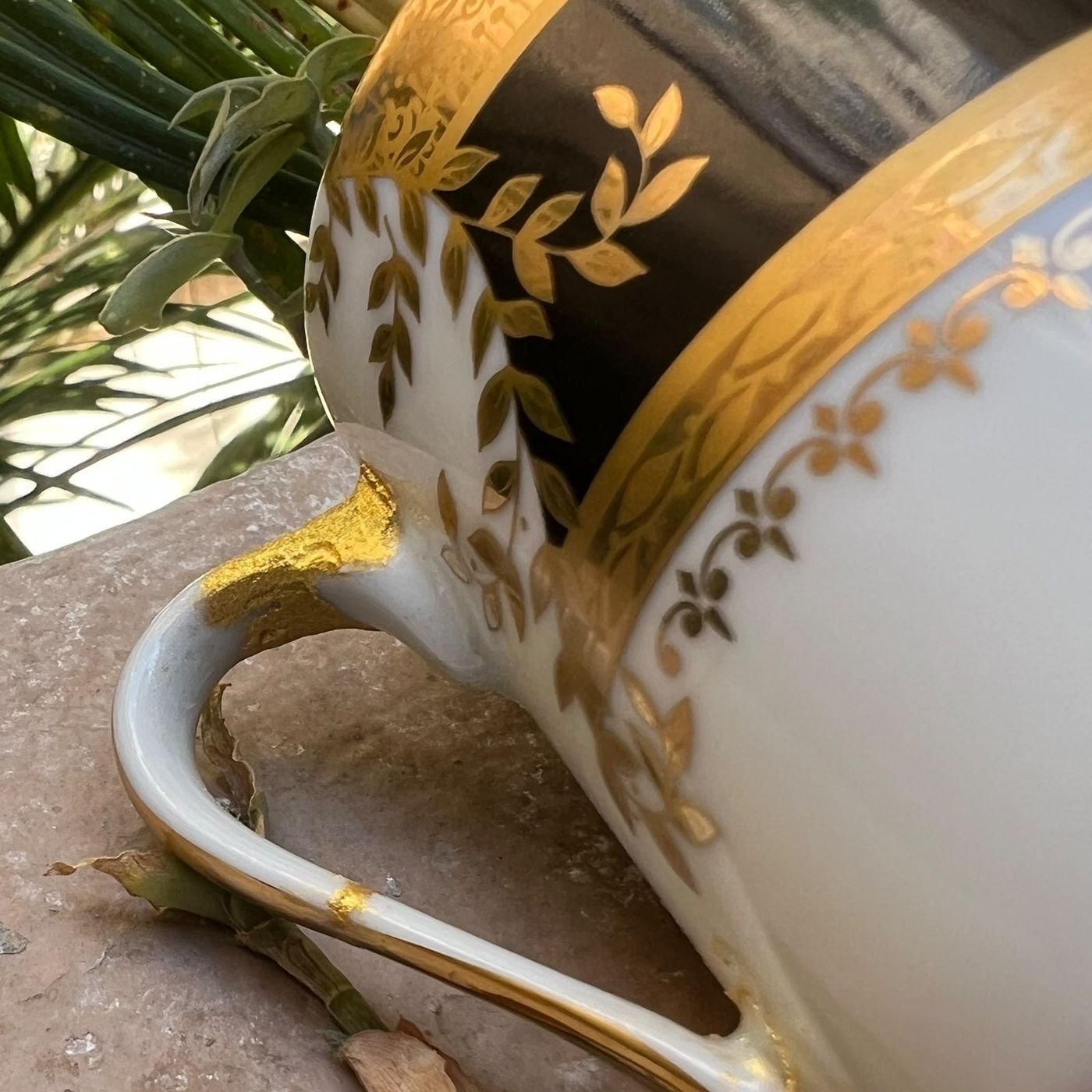
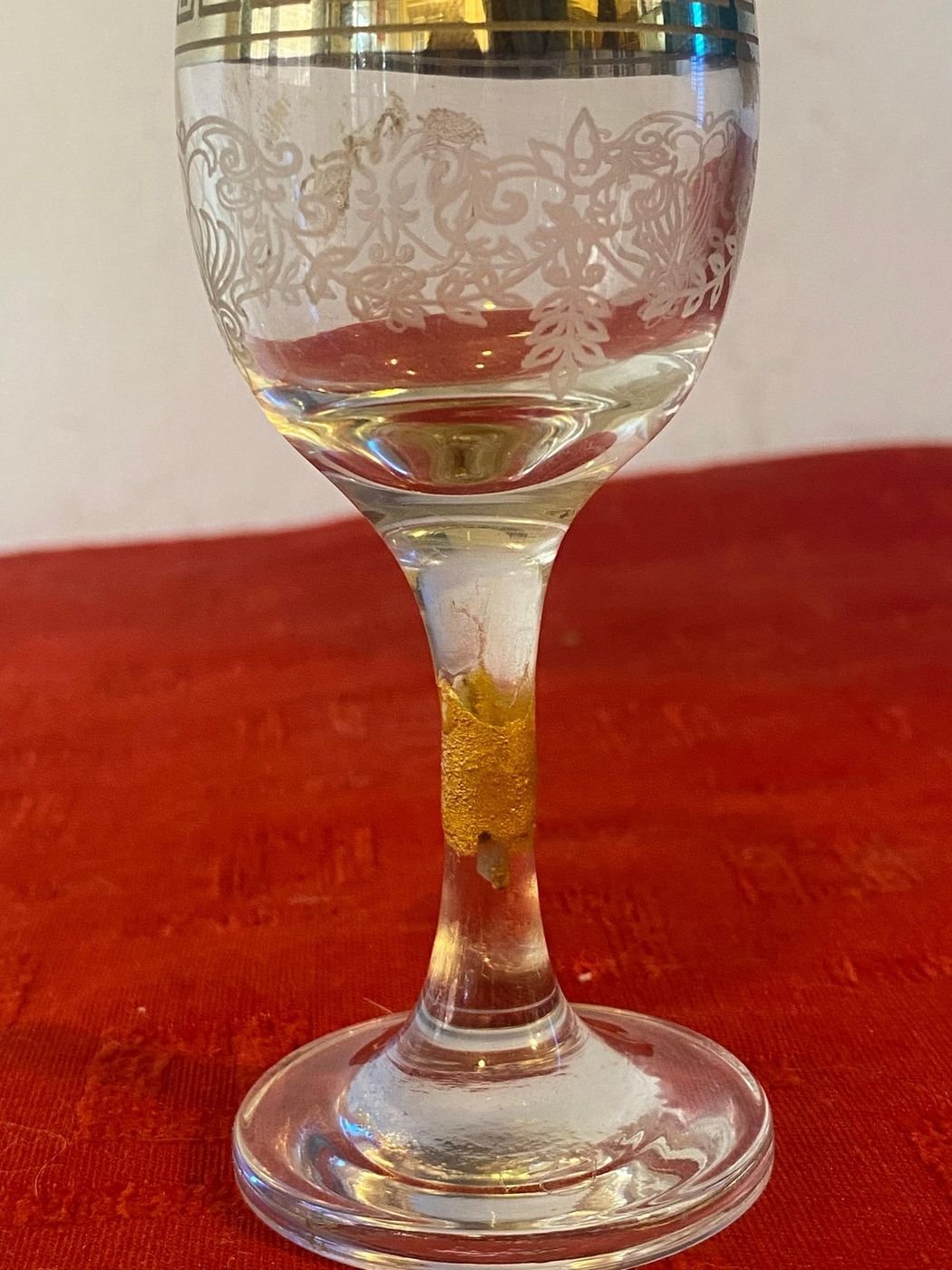
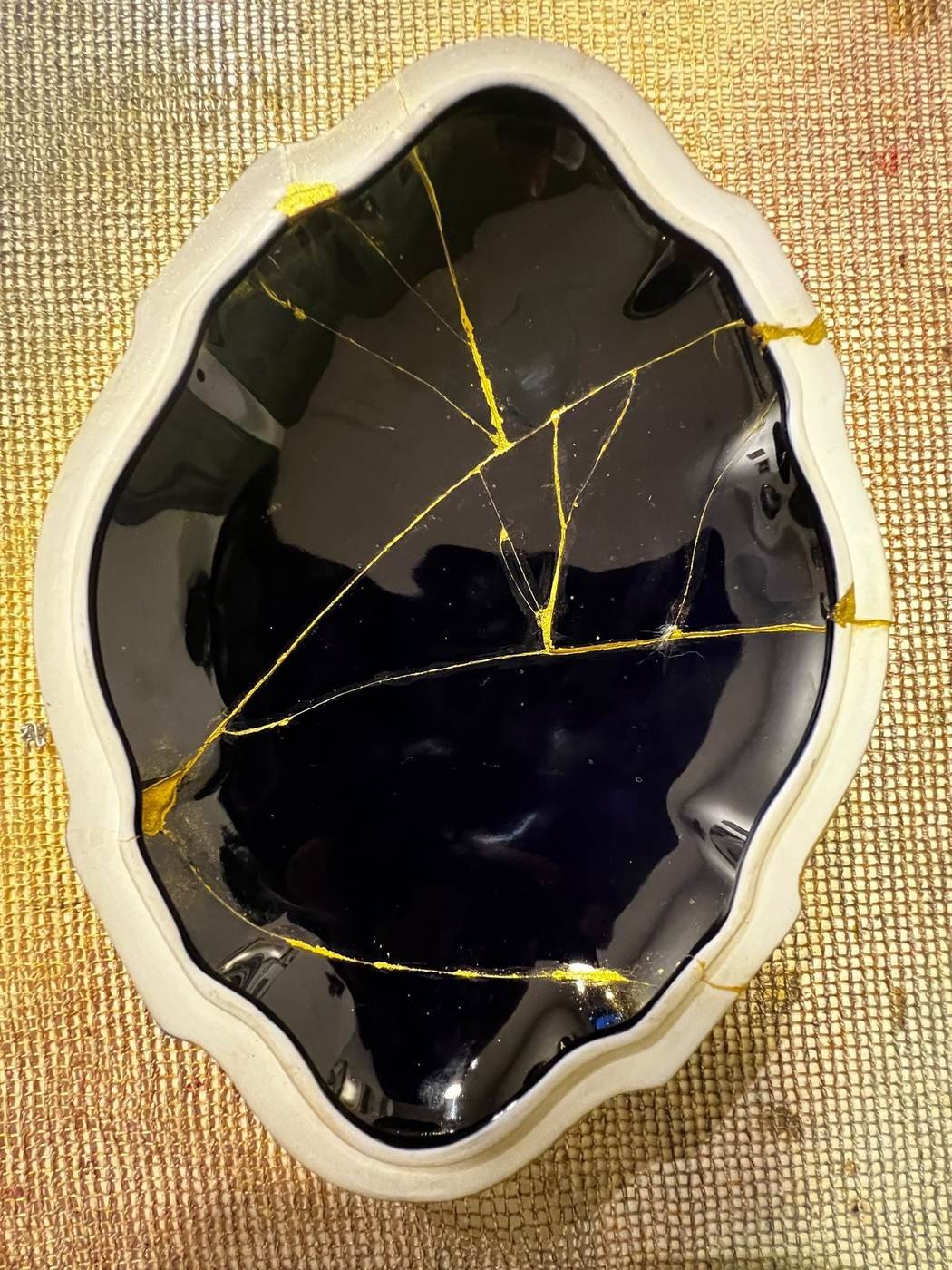
This porcelain pot came to us broken. The photographs below show the repair in progress and the finished piece — the gold is not hiding the break, it is marking it.
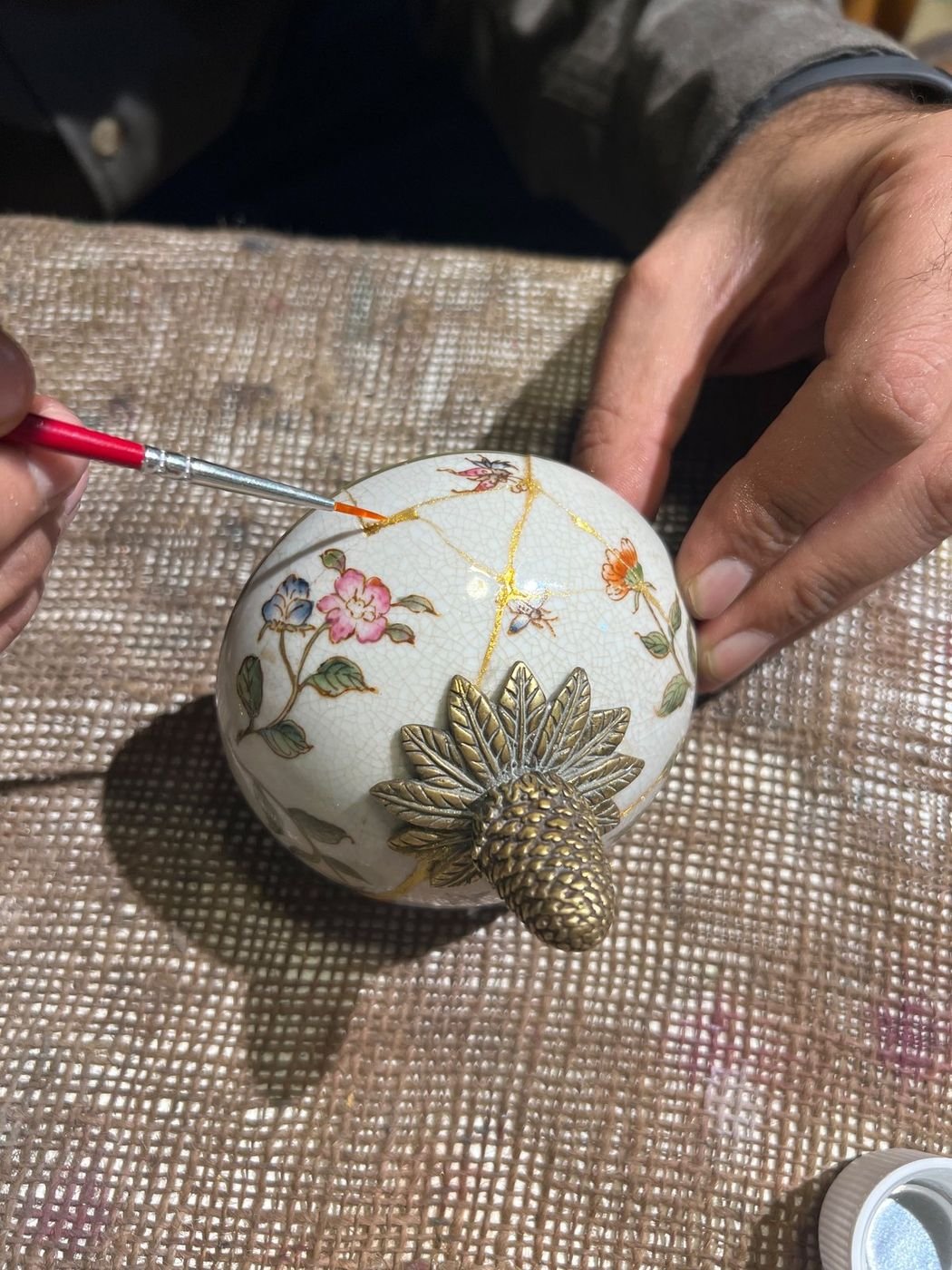
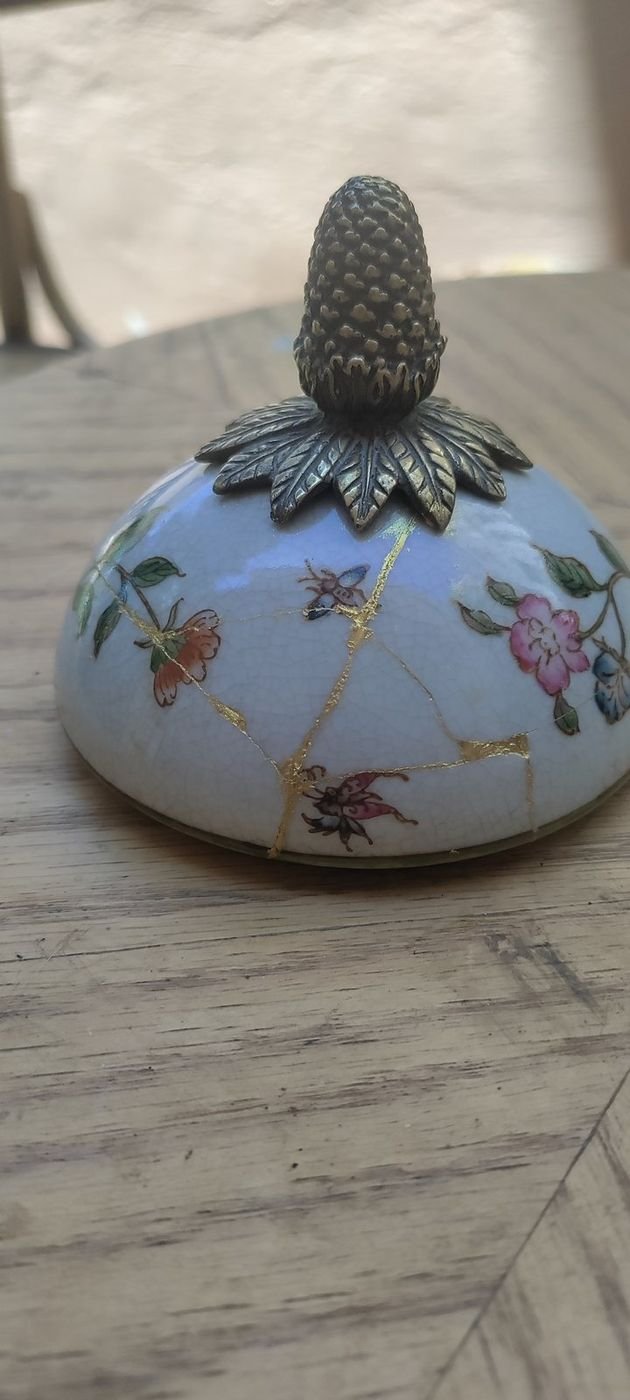
What the work actually involves
Traditional kintsugi is not one step. It is a sequence of them, and almost all of the time is spent waiting for lacquer to cure.
- Cleaning and preparation. Any old glue is removed first. A piece someone has already tried to fix with superglue takes longer, because that has to come off before anything else can begin.
- Joining. The pieces are reassembled with a mix of natural urushi lacquer and rice glue, then left to cure for several days in stable temperature and humidity.
- Filling. Lacquer mixed with terracotta powder fills the cracks and any gaps. Sanded, filled again, sanded again, until the surface is level.
- Base coating. Black lacquer is applied and cured, more than once.
- The gold. Red lacquer goes on last, and while it is still tacky the pure metal powder is sprinkled over it by hand. Once cured it is burnished with an agate stone until it shines.
That is why a traditional repair takes four to eight weeks rather than a few days, and why the finished seam is metal rather than paint.
What it costs
No two breaks are the same, so the final figure comes from seeing the piece. But our rates are fixed, and they will tell you the order of magnitude before you get in touch.
Four finishes, four prices. Gold is the traditional finish and the most striking. Silver is quieter. Bronze is warm and still genuinely beautiful — a real traditional finish, not a compromise. Black or red lacquer is the quietest traditional finish: the seam is finished in urushi itself, with no metal, and it is the most affordable.
Two ways to repair a piece
We work both traditionally and with modern materials. In both, the metal is real — real gold, real silver, real bronze. What changes is what holds the piece together underneath, and that changes the price and the wait.
Traditional — Japanese urushi lacquer
Natural urushi lacquer and real metal powder, applied by time-honoured Japanese methods. Food-safe once fully cured.
| Repair | Measured by | Black or red lacquer | Bronze | Silver | Gold |
|---|---|---|---|---|---|
| Hairline crack & break | per 1 cm along the line | 6 JOD | 8 JOD | 10 JOD | 15 JOD |
| Chip — a piece missing | per square cm rebuilt | 40 JOD | 53 JOD | 71 JOD | 106 JOD |
- Food-safe once fully cured — you can drink from it
- Takes four to eight weeks. Urushi cures slowly and must dry between every coat
- Hand wash only with a mild detergent. Not microwave or dishwasher safe, and keep away from extreme heat such as an oven
- The repair is permanent and ages with the piece
Non-traditional — food-safe resin
Same real metals, modern bonding. Half the price.
| Repair | Measured by | Bronze | Silver | Gold |
|---|---|---|---|---|
| Hairline crack & break | per 1 cm along the line | 4 JOD | 5 JOD | 7.5 JOD |
| Chip — a piece missing | per square cm rebuilt | 27 JOD | 36 JOD | 53 JOD |
- Food-safe once fully cured — we use a certified food-contact resin
- Much faster: usually about two weeks
- Hand wash only with a mild detergent. Not microwave or dishwasher safe, and keep away from extreme heat such as an oven
- The quicker, more affordable choice, with the same real metal finish
Not sure which you need? Both are food-safe once cured. Traditional is the authentic Japanese method and ages with the piece. Non-traditional is ready in about two weeks at half the price.
Minimum charge 45 JOD per piece. Even the smallest repair passes through the same eight stages and the same weeks of curing.
Roughly what to expect
- A mug with one clean 6 cm crack, traditional — 48 JOD in bronze, 60 in silver, 90 in gold
- A bowl with a chipped rim, gap about 1 square cm, traditional — 53 JOD in bronze, 71 in silver, 106 in gold
- A plate broken in three, about 20 cm of break line, traditional — 160 JOD in bronze, 200 in silver, 300 in gold
- That same plate non-traditional, for display — 80 JOD in bronze, 100 in silver, 150 in gold
Send us a photo on WhatsApp and we will give you a proper figure, usually the same day.
Why traditional takes weeks, not days
We use real Japanese urushi lacquer and genuine metal powder — not epoxy with gold paint. Urushi cures slowly and has to dry between every coat, which is why a repair takes four to eight weeks. It is also why the repair lasts, and why the piece is food-safe afterwards. If a studio quotes you a few days for a traditional repair, it is not using urushi — and it should say so plainly, as we do above.
We are the only studio in Jordan doing traditional Kintsugi with genuine Japanese urushi.
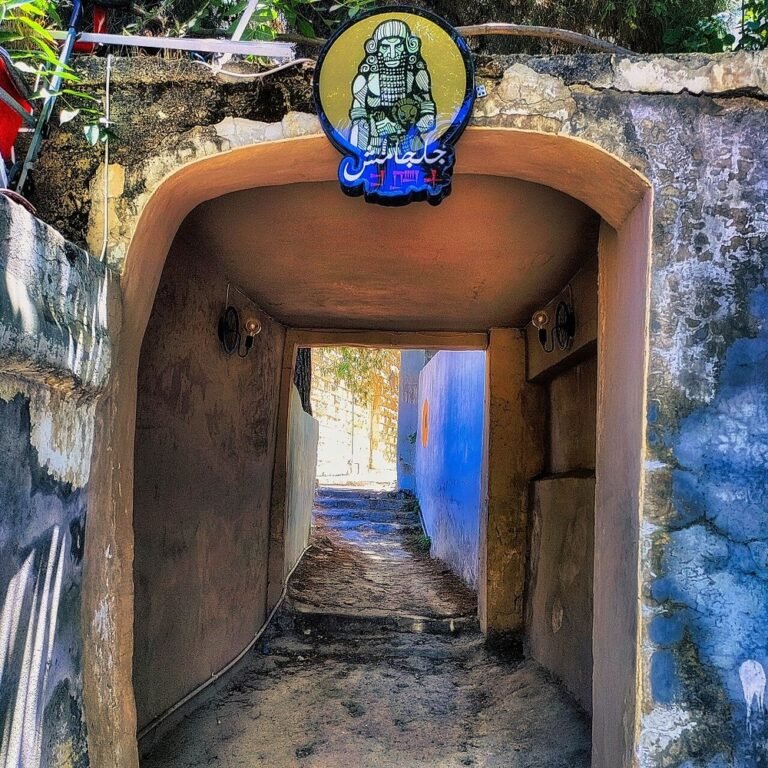
Every repair is done here, by hand, in our studio in a 1930s heritage house in Jabal Al-Lweibdeh — one of the oldest houses in the neighbourhood. You are welcome to bring the piece in person.
How a commission works
The same seven steps whichever method you choose. Nothing is charged until you have seen a real figure and agreed to it.
- Send us photos and rough measurements. On WhatsApp is easiest. Photograph the piece whole, then each break close up, with something for scale — a coin or a finger will do. Tell us roughly how long the cracks are and how big any missing area is.
- We send a preliminary quote and a timeline. Free, and no obligation. If we do not think the piece can be saved, we will say so rather than take the work.
- You approve, and the piece comes to us. Bring it to the studio in Jabal Al-Lweibdeh, arrange delivery within Jordan, or send it to us from abroad. Wrap each fragment separately — and bring every fragment, however small.
- We inspect it in person and confirm the final quote. Photographs hide things: hairline cracks, old glue, crumbling glaze. The figure only becomes firm once the piece is in our hands. If it has moved from the preliminary quote, we tell you why before doing anything.
- A 50% deposit starts the work. The balance is due when you collect. The deposit covers our materials — real gold and urushi are bought per job, not off a shelf.
- The repair begins. Four to eight weeks for traditional, about two for non-traditional. We will send you a photo when it is done, and progress pictures along the way if you would like them.
- You collect your piece. We will show you how to care for it, and what it can and cannot go near.
Send us a photo of the break
No obligation, no charge for the assessment. Message us on WhatsApp and we will tell you honestly what is possible.
Or learn to do it yourself
If you would rather make the repair with your own hands, our two-day Kintsugi workshop teaches the full process, including rebuilding a missing area. You are welcome to bring the piece that matters to you and work on it there.
The gold finish on a repair is the same material we teach in our Gold Leaf Gilding workshop.
Questions
How much does a Kintsugi repair cost?
Our rates are fixed and depend on the method. Traditional urushi: 6 JOD per centimetre of crack in black or red lacquer, 8 in bronze, 10 in silver, 15 in gold; chips are 40, 53, 71 and 106 JOD per square centimetre rebuilt. Non-traditional food-safe resin is half the bronze, silver and gold figures. Minimum charge is 45 JOD per piece. A mug with one 6 cm crack is about 48 JOD traditional in bronze, or 90 in gold. Send us a photo on WhatsApp and we will confirm.
What can you repair?
Ceramics, porcelain, stoneware and some glass. Send a photo and we will tell you honestly whether it can be done.
What if a piece is missing?
That is called rebuilding a missing area. We rebuild and shape the missing section before applying gold, so the object is whole again rather than simply glued.
Can I use the piece afterwards?
Yes. Both our traditional urushi and our food-safe resin repairs are food-safe once fully cured. Wash by hand with a mild detergent. They are not microwave or dishwasher safe, and should be kept away from extreme heat such as an oven.
Do I have to bring the piece in person?
Bringing it to the studio at 26 Al-Farazdaq Street is easiest, as we can look at it with you. Message us first and we will arrange a time.
Can I send a broken piece from abroad?
Yes. Send us photos and rough measurements on WhatsApp or by email for a free quote. Once you approve, post the piece to our studio in Amman by courier (DHL, Aramex or FedEx work best), with each fragment wrapped separately. When the repair is finished we send you photos and courier it back to you. The client pays shipping both ways and any customs charges.
Can you teach me to do it myself?
Yes. Our two-day Kintsugi workshop teaches the full process including rebuilding a missing area, and you are welcome to bring your own broken piece to work on.
Do I pay anything up front?
A 50 per cent deposit once you have approved the final quote, with the balance due when you collect. Nothing is charged for the initial photo assessment, and nothing is charged before you have a real figure in front of you.
Which should I choose — traditional or non-traditional?
Both are food-safe once cured. Traditional urushi is the authentic Japanese method and takes four to eight weeks. Non-traditional food-safe resin costs half and takes about two weeks. The metal is real either way — genuine gold, silver or bronze in both.