School Programs in Amman: Art Workshops That Give Students Their Heads Back
Hands-on ceramics, glass and traditional Japanese craft for school groups — in a 1930s heritage house in Jabal Al-Lweibdeh, or at your school. Built for IB CAS Creativity, and for students who are carrying more pressure than they show. We take all ages and any group size, as long as they come as one school — a single class or a whole year group, as a school trip or a recurring programme. See all our workshops, or book a workshop for a small group.
Why schools bring students here
Because for two or three hours, a student is not being assessed. They are making something with their hands, it is going badly at first, and nobody is grading it. That turns out to matter more than it sounds.
of participants in a Drexel University study had measurably lower cortisol — the body’s main stress hormone — after just 45 minutes of making art. The effect held regardless of artistic talent or previous experience. Beginners benefited as much as artists.
Kaimal et al., published in Art Therapy, 2016. Every workshop we run is comfortably longer than 45 minutes.
Working with clay does something specific. It is slow, tactile and repetitive, and it engages the parasympathetic nervous system — the part of the body responsible for calming down. A 2024 study of a university ceramics course found significant reductions in student anxiety over the length of the course.
It is also one of the few activities left where a phone is genuinely inconvenient. Wet clay and touchscreens do not mix. Students put them down without being told to.
Built for IB CAS — the Creativity strand
Amman has thirteen IB World Schools. Every Diploma student must complete CAS, and the Creativity strand has one strict condition: the student has to take part in making something. Attending a performance does not count. Throwing a pot does.
It genuinely qualifies
Ceramics, kintsugi, stained glass, glass painting and gilding all sit squarely inside the IB’s own definition of Creativity — arts and design where the learner is part of the creative process.
Documentation included
Every student leaves with a certificate of participation recording the workshop, the hours and the strand — so your CAS Coordinator has evidence without chasing anyone for it.
Reflection built in
We finish with a short structured reflection students can lift straight into their CAS portfolio, framed around the IB learning outcomes rather than “what I did today”.
It can be a series
CAS asks for sustained engagement, not one afternoon. Multi-session blocks across a term give students a real skill and give you a defensible CAS entry.
The same applies below Diploma level. MYP Arts, PYP units of inquiry on culture and material, and Design courses all map onto what happens in the studio. Tell us the unit and we will shape the session around it.
What students actually do
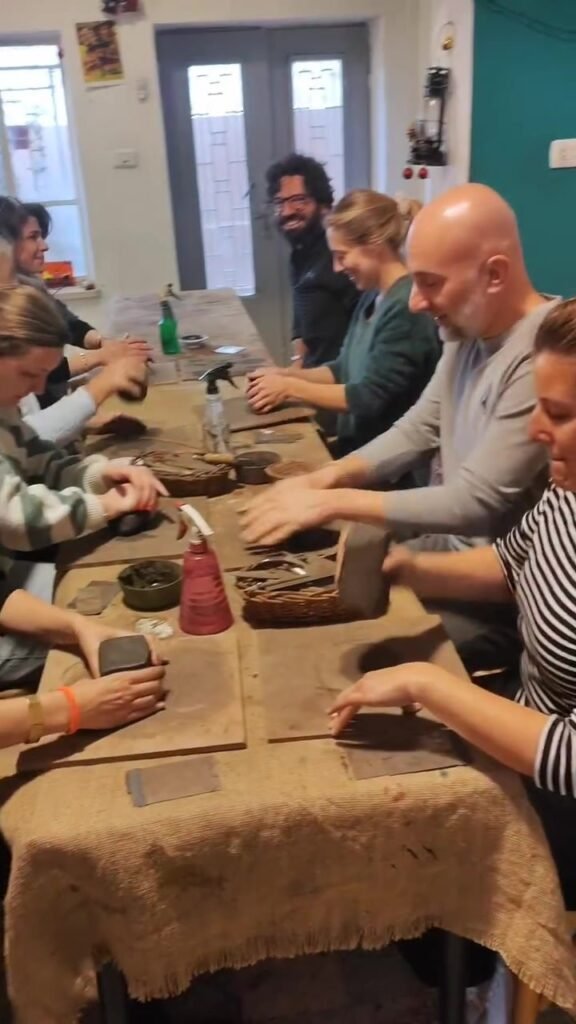
Nothing is a demonstration. Every student works with their own materials and takes their own piece home.
- Pottery & hand-building — pinch, coil and slab building. The most physical, and the best for a group that arrives wound up.
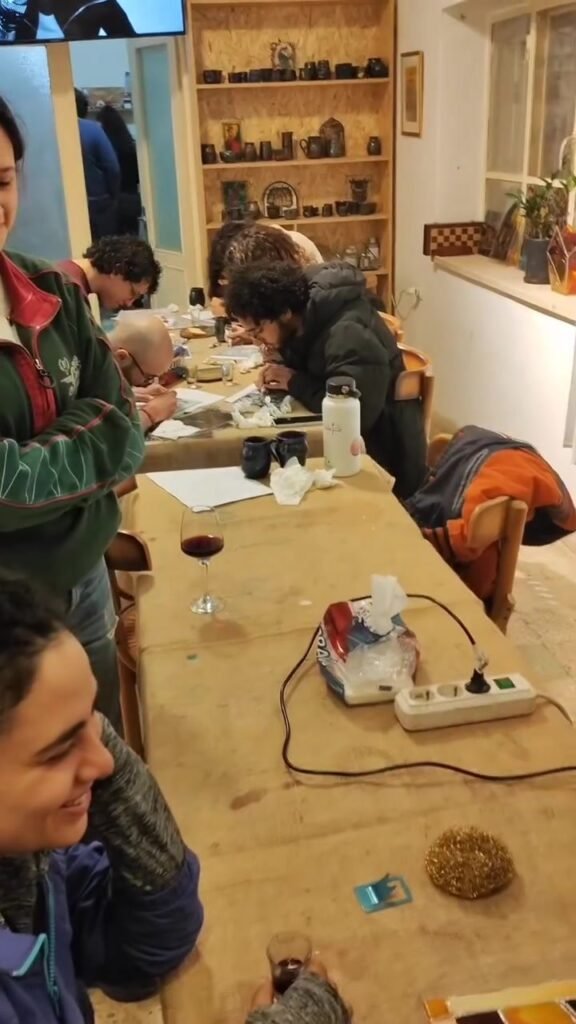
- Pottery painting — underglaze work on a ready-made piece. Calm, precise, accessible to every ability. Takes the largest groups.
- Japanese Kurinuki — carving a vessel out of a solid block of clay. Quiet, meditative, and unlike anything they do at school.
- Kintsugi — repairing broken pottery with gold. The philosophy lands hard with teenagers: the break becomes the most beautiful part.
- Stained glass — cutting, foiling and soldering real glass. Older students only, and the one they talk about afterwards.
- Glass painting & sacred icons — drawing and painting on glass, with a direct line into the region’s own iconographic tradition.
- Raku — fire, smoke and unpredictable results. Best as a finale, weather permitting.
Two ways to run it
They come to us
Up to 40 students in one session, across the studio and courtyard of a 1930s heritage house — one of the oldest in Jabal Al-Lweibdeh. Getting out of the school building is half the point. Larger year groups are split across sessions or rotated through the day.
We come to you
We bring materials, tools and instructors to your school for classes that cannot travel, for whole-year-group days, or for wellbeing weeks. Firing happens back at the studio and finished pieces are returned.
The building is part of the lesson
The studio is a 1930s heritage house in Jabal Al-Lweibdeh — one of the oldest houses in the neighbourhood, from the years when Amman was becoming a capital. Stone, arches, high ceilings, a courtyard.
For a history or art department that is not decoration, it is material. Students spend the day making things by hand in a building that was made by hand, in the oldest creative quarter of the city. We are the only studio in Jordan teaching Kintsugi, Kurinuki and Raku, so it is also not a trip they can repeat somewhere else.
Common questions
How many students can you take at once?
Up to 40 in a single session at the studio. Larger year groups are split across sessions or rotated through different workshops across the day. If we come to your school, numbers can be higher — tell us the group and we will tell you honestly what works.
Do students need any experience?
None. Every workshop is built for complete beginners, and the research on stress reduction found the benefit does not depend on being any good at it.
Does this count for IB CAS?
Yes, for the Creativity strand. Students take part in making the work rather than watching it, which is the IB’s own test. Each student receives a certificate recording the workshop and hours, plus a structured reflection for their CAS portfolio.
What does it cost?
School groups are quoted per group rather than from a fixed price list, because the number of students, the workshop and whether we travel to you all change the figure. Tell us what you are planning and we will send a quote.
How far in advance should we book?
As early as you can, particularly for exam-season wellbeing weeks and end-of-term dates, when several schools want the same window.
Do students take their work home?
Yes. Everything is fired and finished. Ceramic pieces need firing time, so we arrange collection or delivery to the school once they are ready.
Can you build the session around a unit we are teaching?
Yes. Send us the unit — MYP Arts, a PYP unit of inquiry, a Design brief, or a history topic — and we will shape the workshop around it rather than running a generic session.
Bring your students
Tell us the year group, roughly how many students, and what you are hoping they get out of it. We will come back with options and a quote.
Enquire about a school visit
WhatsApp us
Bringing colleagues rather than students? We run the same workshops as corporate team building for companies, NGOs and embassies, and as private events and celebrations.
Read them on Google
◉ Tripadvisor Travellers’ Choice 2025 & 2026 — see the reviews
“It is an art studio and school. My friends and I went for a Japanese Pottery session. It was a lovely experience. Must try.”Google review