Carve your own chawan, the bowl used to whisk and drink matcha in the Japanese tea ceremony, from a solid block of clay. A calm, hands-on workshop in a 1930s heritage house in Jabal Al-Lweibdeh, Amman. No experience needed.
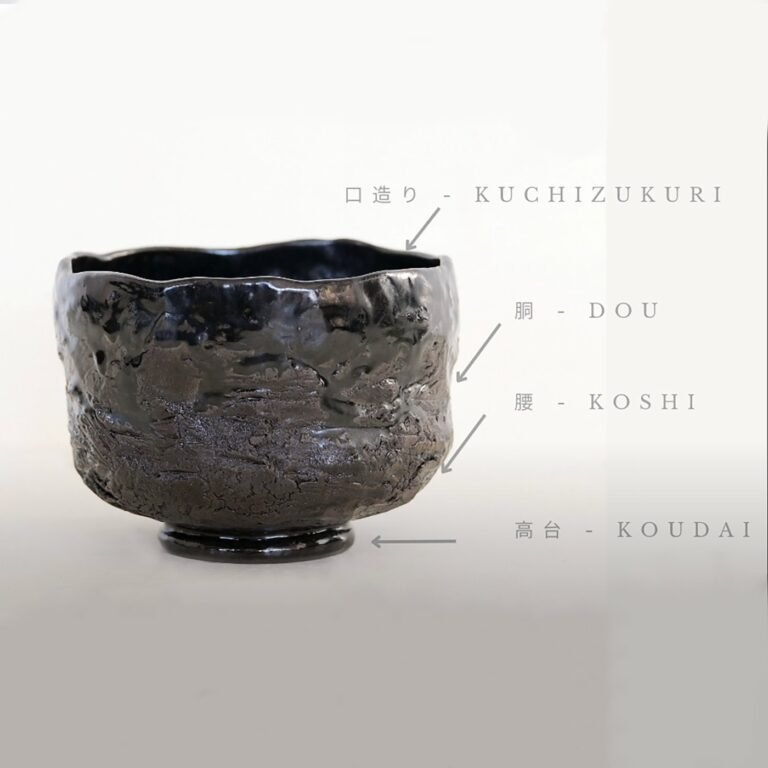
What is a chawan?
A chawan (茶碗) is a Japanese tea bowl. In the tea ceremony, chanoyu, matcha is whisked with a bamboo whisk right inside the bowl, and the guest drinks from it holding it in both hands. That is why a chawan is wider and deeper than a cup, with walls high enough to whisk without splashing and a foot that sits steady on the mat.
A short history
- From China: Zen monks brought tea and Chinese tea bowls to Japan in the Kamakura period (1185–1333). The most admired were dark tenmoku bowls.
- Korean bowls: in the 1500s, tea masters turned to simple Korean rice bowls, such as the Ido bowls, for their rough and humble beauty.
- Sen no Rikyū (1522–1591) shaped the quiet style of tea called wabi-cha. He preferred asymmetrical bowls with rough surfaces over perfect, precious ones.
- Chōjirō and Raku: Rikyū asked Chōjirō, a tile maker, to make tea bowls by hand rather than on the wheel. Each one was different. In 1598 his workshop received a seal with the word raku, and Raku ware was born.
The philosophy: beauty in imperfection
The chawan carries the idea of wabi: humble, simple and quiet. An uneven rim, a thumb mark or a crack in the glaze is not a fault; it is what makes a bowl alive and unlike any other. This is the same spirit as wabi-sabi and as Kintsugi, the Japanese art of repairing a broken bowl with gold.
A chawan is made to be held, not only looked at. The guest takes it in the left palm, steadies it with the right hand, turns it, drinks, and then looks closely at it, even turning it over to admire the foot. A good bowl feels balanced and warm in the hands.
The parts of a chawan, and why they matter
Where your lips touch. It should feel good to drink from.
The walls. High enough to whisk matcha without splashing.
The curve down to the base, where your hands hold the bowl.
Lifts the bowl, keeps it steady and lets you hold and turn it.
The view into the bowl, where the tea is whisked.
A small hollow at the bottom where the last drops of tea gather.
How we make it: the Kurinuki way
Instead of throwing on a wheel, you carve your chawan from a solid block of clay, the Japanese technique called Kurinuki (刳り貫き, “to hollow out”).
- Shape the outside of the block by cutting and tapping it into a bowl form.
- Hollow the inside with loop tools, leaving walls thick enough to hold heat.
- Carve the foot (kōdai) and the rim, each a little different.
- Add texture and tool marks. These become the character of your bowl.
- We dry, fire and finish it for you. Your chawan is ready in about 7 days.
No experience needed: we guide every step, in English or Arabic. Leaving Amman soon? We can rush your piece in 2 to 3 days at no extra cost.
Make your own chawan
25 JOD per person, about 2 hours, snacks, coffee and tea included. Tripadvisor Travellers’ Choice 2025 and 2026.
Questions
What is a chawan used for?
A chawan is the bowl used to prepare and drink matcha in the Japanese tea ceremony. The tea is whisked inside the bowl with a bamboo whisk. You can also use yours for matcha at home, or as a small bowl.
Do I need any experience?
No. The workshop is for beginners, and we guide every step. Adults and children are welcome.
How long does it take, and when can I take my bowl home?
The workshop takes about 2 hours. We then dry and fire your chawan, and it is ready in about 7 days. If you are leaving Amman sooner, we can rush it in 2 to 3 days at no extra cost.
How is a Kurinuki chawan different from a wheel-thrown bowl?
A Kurinuki chawan is carved from a solid block of clay rather than thrown on a wheel. Every cut shows, so each bowl is unique, which fits the Japanese love of beauty in imperfection.
How much does it cost?
25 JOD per person, including clay, tools, firing, snacks, coffee and tea.
Where are you?
26 Al-Farazdaq Street, Jabal Al-Lweibdeh, Amman, a short walk from Paris Circle. See how to visit us.